Underage drinking takes place pretty much everywhere in the world. In the United Kingdom and most places in Europe, the drinking age is 18. Everywhere in the United States, the age is a bit higher ranking at 21.
As time goes on and society’s rules evolve, we see that gender roles and gender identities have become more blurred. What is traditionally considered feminine and masculine don’t necessarily hold the same definitions. According to the paper written by Hui G. Cheng and James C. Anthony, both male and female teens were observed and surveyed. Scholars took into account the ever shrinking “gender gap” they also “note how traditional macro-level gender inequalities or increasing equalities might be at play (Cheng). Underage drinking was more defiant in males, however now we see that it affects all genders.
What Drinking Does to the Brain
The short video above explains how underage drinking can deteriorate the brain, being that the human brain isn’t fully developed till the age of 25. By drinking at 21, it’s even a risk. However, most young adults begin drinking at the age of 18 in Europe, specifically the United Kingdom. According to the book Underage Drinking: Examining and Preventing Youth Use of Alcohol, studies report that it increases risk for disability and may be detrimental to the developing brain (Edvin & Harald 9). In the United States the age is 21, where even there, as the age is a bit higher, there is still a chance for deterioration. We as humans all know that most young adults don’t wait till the ages or 18 or 21 to start experimenting with alcohol. This act of disobeying the law and most parental consent is an example of deviance.
United States Underage Drinking Issues
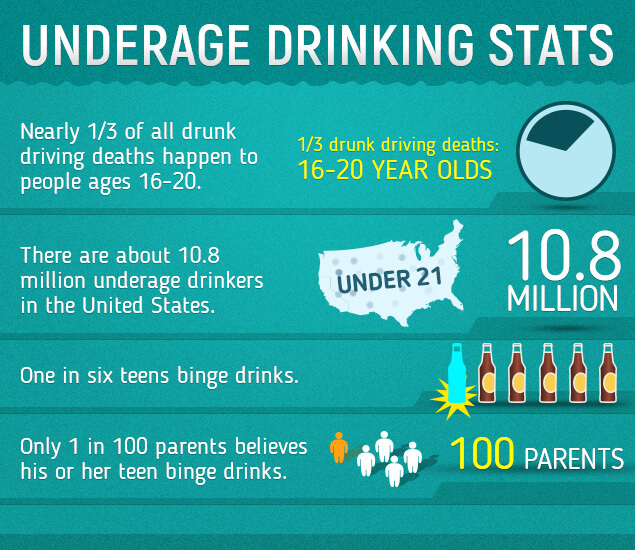
According to the statistic shown to the left, there are 10.8 million underage drinkers in the United States alone. According to the Youth Access to Alcohol section in the Juvenile justice Bulletin, drinking for teens is an experimental act, and are most likely provided the resources by parents or older adults (Hanes).
The subculture of underage drinking has become very prominent in the United States leading to many repercussions such as DWI’s, life changing injuries and death. People can do everything to enforce the law of the drinking ages, however it is hard to believe that young adults will actually listen and enforce within themselves and their peers. In the book Underage Drinking: Examining and Preventing Youth Use of Alcohol, recent data suggests that 74.3% of teens from grades 9-12 consume alcohol on multiple occasions, of that 74.3%, 43.3% of those underage drinkers consume alcohol on a regular basis, and 25.5% of them are binge drinkers (Edvin & Harald 10). And although the drinking age may be 21 in the United States, 20% of alcohol is consumed by kids ages 12-20 years of age (Edvin & Harald 11).
United Kingdom’s Underage Drinking Issues

While all of this is happening in the United States, kids at the age of 18 are legally drinking in the United Kingdom. According to the study Youth Exposure to Alcohol Advertising on Television in the UK, Netherlands and Germany, kids from ages 10-15 were exposed to more alcohol related advertisements than adults (Patil, Sunil, et all 563). Due to the fact that these alcohol advertisements are deemed for the youth in the United Kingdom to see, the United Kingdom implemented restrictions on the amount of times an alcohol advertisement can be aired on television in order to try to prevent underage drinking (Patil, Sunil, et all 564). Just because they tried to prevent it however, does not mean the kids will abide by this. In contrast, there was another study about the number of kids in the United Kingdom under the age of 18 who were admitted to hospitals due to alcohol poisoning and acute drunkenness. There were on average, 36 underage kids sent to the hospital per day in the United Kingdom for alcohol related illnesses (Healey, Christine, et all 126).
Underage Drinking and the Deviance Behind It
There are a number of factors that lead up to teenagers and underage drinking. Teens often associate drinking with the factor of being an adult (Hegamin-Younger & Merrick 112). Peer pressure, home life and parental influences (i.e. if the mother or father had an issue with drinking in the past). Deviant Behavior is defined by Becker as any person who breaks the rule of social norms (Becker 1997). The culture of underage drinking is often seen as cool or popular, the brim of adulthood, hence why so many teens across the world do participate in underage drinking.
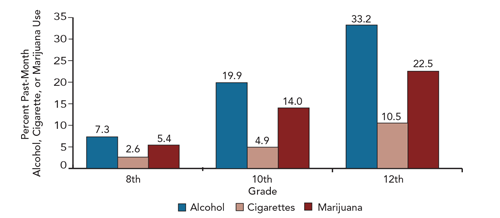
In the image above, we can see that there are more teenagers participating in underage drinking than smoking cigarettes and marijuana. Alcohol has a much easier way to retain access to, due to the fact that it is in many homes spread across the world no matter the time of year or the occasion. While cigarettes and marijuana are much harder to obtain for teenagers, family members or older friends may not smoke either one. Therefore, underage teens fall back on alcohol because it has easy access.
Underage drinking is seen as deviant because it breaks the law. In the United States, the federal law states that no person can consume alcohol until they are at the age of 21. In the United Kingdom, the law states no one can consume alcohol until they are 18. Those who disobey that law are considered rule breakers, and therefore breaking social norms. The underage drinkers according to Becker’s The Outsiders, are considered offenders (Becker 1997). Becker says “social groups create deviance by making the rules whose infractions constitutes as deviance”(Becker 9). Becker says the degree to which other people will respond to a given act of deviance varies greatly. Some kids or teenagers who take part in underage drinking do not get caught, the ones that do are considered the social group that committed an act of deviance because of the certain law they broke.
The Underage Drinking Repercussions
Underage drinking leads too many things like injury, assault (physical or sexual), jail time or death. In the United States alone from the years of 2006-2010 there were about 4,358 deaths (National Institute on Alcohol Abuse and Alcoholism, U.S. Department of Health and Human Services). A majority of those deaths were from motor vehicle crashes. The act of drinking impairs judgment for anyone. For underage drinking, since the brain is not fully developed till the age of 25, impairs the teens a bit more. The more impaired the consumption of alcohol is, the more likely the person is to make an “impaired judgement”. Impaired judgments are often referred to but not limited too, drinking and driving, unexpected sexual acts, and aggressive or violent behavior. The act of underage drinking also can potentially cause alcohol problems later in life (National Institute on Alcohol Abuse and Alcoholism, U.S. Department of Health and Human Services).
Cultural and Social Norms
As the years pass, the social and cultural norms are subjected to change greatly. New laws are made, and adjustments to laws are made. According to Carla T. Main’s Underage Drinking and the Drinking Age, in the 19th century, social and cultural norms prevented young people from drinking (Main 35). Now in the 21st century, social and cultural norms have made changes. In the 19th century, most kids did not disobey their parents and act out. In the year 2019, it is common for teenagers to rebel against their parent or guardian. This type of behavior leads to being labeled as deviant, or being involved in acts that can be considered deviant.
How Do We Put a Stop to Underage Drinking?
Underage drinking is inevitable. No matter what the law says, there will always be kids who will have a sip of alcohol in their life while they’re under the ages of 18 (United Kingdom) or 21 (United States). Parents can play a role in trying to prevent their child from underage drinking, there can also be programs, like a scared straight program to keep kids too worried about the repercussions that could potentially follow. There can also be family and school based interventions that provide the skills and willpower to say no to peer pressure or any type of pressure to drink. The underage drinking epidemic is rising and teens and their families are paying the price for it. If everyone works together to prevent the deviant behavior of underage drinking, there is definitely hope.
Discussion Questions:
- There is a lot of controversy lately about lowering the drinking age from 21 to 18, how do you think lowering it would affect teenagers and society today?
- Do you think underage drinking became such an epidemic in the world, particularly the United States?
References
Academic Sources:
Cheng, Hui G., and James C. Anthony. “A New Era for Drinking? Epidemiological Evidence on Adolescent Male–female Differences in Drinking Incidence in the United States and Europe.” Social Psychiatry and Psychiatric Epidemiology: The International Journal for Research in Social and Genetic Epidemiology and Mental Health Services, vol. 52, no. 1, Jan. 2017, pp. 117–126. EBSCOhost, doi:10.1007/s00127-016-1318-0.’
Healey, Christine, et al. “Underage Drinking in the UK: Changing Trends, Impact and Interventions A Rapid Evidence Synthesis.” International Journal of Drug Policy, vol. 25, no. 1, Jan. 2014, pp. 124–132. EBSCOhost, doi:10.1016/j.drugpo.2013.07.008.
Patil, Sunil, et al. “Youth Exposure to Alcohol Advertising on Television in the UK, the Netherlands and Germany.” European Journal of Public Health, vol. 24, no. 4, Aug. 2014, pp. 561–565. EBSCOhost, doi:10.1093/eurpub/cku060.
Bräker, Astrid B., and Renate Soellner. “Alcohol Drinking Cultures of European Adolescents.” European Journal Of Public Health, vol. 26, no. 4, Aug. 2016, pp. 581–586. EBSCOhost, doi:10.1093/eurpub/ckw033.
Bosque-Prous, Marina, et al. “Adolescent Alcohol Use and Parental and Adolescent Socioeconomic Position in Six European Cities.” BMC Public Health, vol. 17, Aug. 2017, pp. 1–10. EBSCOhost, doi:10.1186/s12889-017-4635-7.
Main, Carla T. “Underage Drinking and the Drinking Age.” Policy Review, no. 155, Jan. 2009. EBSCOhost, search.ebscohost.com/login.aspx?direct=true&db=eric&AN=EJ871038&site=eds-live. Hegamin-Younger, Cecilia, and Joav Merrick. Caribbean Adolescents : Misuse and Abuse of Alcohol. Nova Science Publishers, Inc, 2017. EBSCOhost, search.ebscohost.com/login.aspx?direct=true&db=nlebk&AN=1455156&site=ehost-live.
Disney, Lynn D., et al. “The Effect of Internal Possession Laws on Underage Drinking among High School Students: A 12-State Analysis.” American Journal of Public Health, vol. 103, no. 6, June 2013, pp. 1090–1095. EBSCOhost, doi:10.2105/AJPH.2012.301074.
Website Sources:
“Underage Drinking.” Caron, www.caron.org/understanding-addiction/underage-drinking?gclid=EAIaIQobChMImbuSkdX14gIVRB6GCh24GQptEAAYASAAEgIZOvD_BwE.
“Underage Drinking.” National Institute on Alcohol Abuse and Alcoholism, U.S. Department of Health and Human Services, Feb. 2017, www.niaaa.nih.gov/publications/brochures-and-fact-sheets/underage-drinking.
Lerner, Jane. “W. Haverstraw Woman, 22, Killed in Stony Point Crash.” Lohud.com, Westchester, 14 Dec. 2014, www.lohud.com/story/news/2014/12/13/woman-killed-stony-point-crash/20352095/
Cline, Sara. “Man Pleads Guilty in Clifton Park Underage Drinking Death.” Times Union, Times Union, 18 June 2019, www.timesunion.com/news/article/Man-pleads-guilty-in-connection-to-Clifton-Park-14015900.php.
“Alcohol (for Teens).” Edited by Steven Dowshen, KidsHealth, The Nemours Foundation, Sept. 2016, kidshealth.org/en/teens/alcohol.html.
Books From Class
Becker, Howard S. Outsiders: Studies in the Sociology of Deviance. Free Press, 1997.



 Emily Quattrocchi's Blog